
Scaling Your Impact: How to Leave the Classroom Without Leaving Your Calling
Show Notes
Is the teacher guilt of leaving the classroom holding you back from your next chapter?
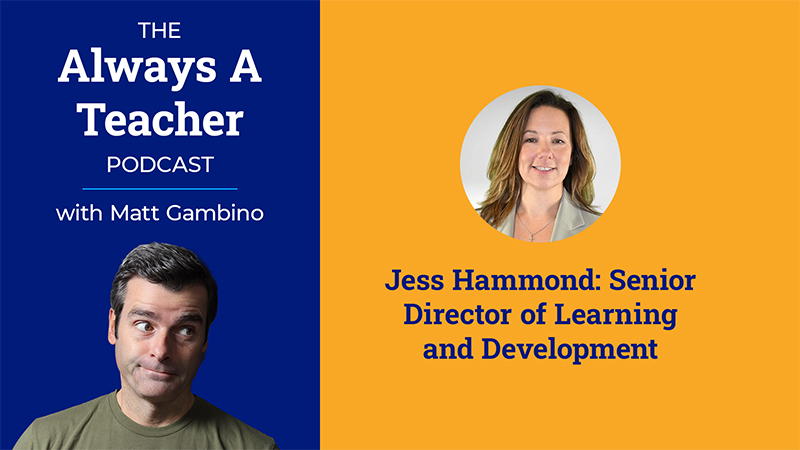
For Jess Hammond, the decision to leave her Pre-K students was heart-wrenching, but it opened the door to a career where she now impacts thousands of classrooms instead of just one. In this episode, Jess opens up about the emotional reality of transitioning out of Early Childhood Education (ECE) and how she landed a dream role at Frog Street, a company that perfectly aligns with her passion for little learners.
- The Emotional Toll: Jess discusses the very real teacher guilt associated with leaving the classroom and how she navigated the feeling that she was abandoning her students to prioritize her own growth.
- Redefining Just a Teacher: How Jess overcame the stigma that ECE educators are babysitters and recognized that managing a classroom of four-year-olds requires elite-level project management and negotiation skills.
- Finding Your Tribe: The importance of finding an organization (like Frog Street) that shares your educational values so the transition feels like an evolution of your calling, not a departure from it.
- The Learning Curve: Jess shares her experience tackling the corporate learning curve—from mastering new software to understanding business travel—and why a teacher’s figure-it-out attitude is the ultimate corporate superpower.
- Scaling Your Impact: A look at her role as Senior Director of Professional Learning and how she uses her classroom experience to design training that actually respects and engages educators.
Episode Article
One of the heaviest burdens teachers carry when they consider a career change isn't the fear of the unknown—it’s the guilt.
It’s the feeling that by choosing yourself, you are somehow failing your students.
I hear this constantly, especially from Early Childhood educators who play such a pivotal, nurturing role in their students' lives. They worry that leaving the classroom means they are turning their backs on their calling.
My guest this week, Jess Hammond, faced that exact emotional hurdle.
Jess is now the Senior Director of Professional Learning at Frog Street, a premier provider of early childhood curriculum. But before she was leading PD sessions across the country, she was right there on the rug with her Pre-K students.
In our conversation, Jess was incredibly honest about her transition. She didn't sugarcoat the difficulty of that final day in the classroom. She described the tears and the feeling that she was giving up on her kids.
But she also shared the moment her perspective shifted.
She realized that by staying in a position where she was burned out, she wasn't giving her best to her students. She began to wonder: What if I could help the teachers who are teaching the students?
Jess’s journey is a testament to the idea of scaling your impact.
She didn't stop being an educator when she packed up her classroom; she just changed her audience. Now, instead of impacting 20 students a year, she supports thousands of teachers, who in turn impact tens of thousands of students.
One of my favorite parts of this interview is when Jess tackles the I'm just a teacher mindset, particularly regarding Early Childhood Education.
She points out that if you can manage the chaos, emotions, and logistics of a Pre-K classroom, the corporate world is actually quite manageable. The ability to multitask, to read a room, and to pivot when a lesson (or a meeting) goes sideways is a direct transfer of power from the classroom to the boardroom.
Jess admits there were things she had to learn. She had to get comfortable with expense reports, travel logistics, and corporate jargon.
But as she proves, those are just skills. They can be learned.
The heart of a teacher—the empathy, the resilience, and the desire to see others succeed—cannot be taught. That is the magic you bring with you.
If you are struggling with the guilt of wanting something new, let Jess’s story be your permission slip. You aren't leaving your vocation behind; you might just be finding a bigger stage for it.